Getting started
Sign in with GitHub
Orbit MD 1.1 and later.
Signing in to GitHub in Orbit does two things:
- Private sites open with no other setup — no Terminal, no GitHub CLI, no SSH keys. Orbit opens, updates and publishes them with your sign-in.
- Your GitHub access decides what you can do on each site: publish, edit and ask to publish, or only look. No one sees a Publish button GitHub would refuse.
It’s free, on every plan. Nothing goes to us: Orbit talks to GitHub directly, and your sign-in stays on your computer, in its Keychain.
Signing in
- Click Sign in with GitHub on Orbit’s start screen (or Help ▸ GitHub Account…).
- Orbit shows a short code and the address to enter it at,
https://github.com/login/device. - Open that address in the browser that’s signed in to the GitHub account you want Orbit to use. Open in default browser does it for you; if your account is in another browser or a private window, use Copy link and paste it there.
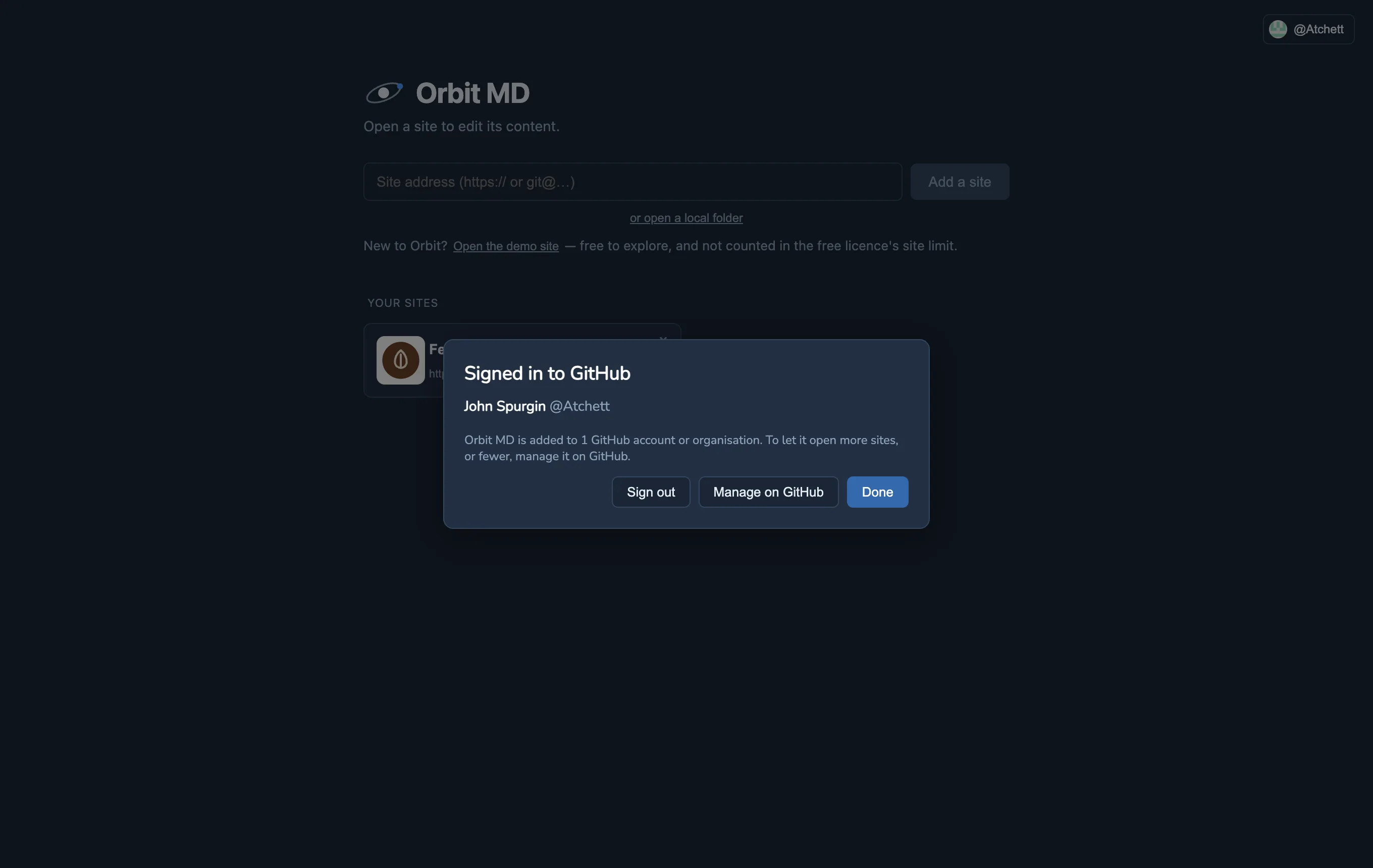
- Enter the code and choose Authorize Orbit MD. Orbit notices within a few seconds and shows your name at the top right.
GitHub’s page says Orbit MD will “act on your behalf”. That’s GitHub’s wording for every app that works as you: your edits are saved as you, with your own access — so GitHub still decides what you can publish. Orbit can only read and change files in the sites Orbit MD has been added to. It can’t change your account, delete anything, or see other repositories.
Adding Orbit MD to your sites
Orbit’s sign-in only reaches the repositories Orbit MD has been added to on GitHub — you choose which.
- Your own repositories: after signing in, Orbit offers Add Orbit MD on GitHub. Pick your account, then Only select repositories and the sites you want Orbit to edit (or All repositories).
- A company’s organisation: an organisation owner adds it the same way, for the organisation’s sites. If you aren’t an owner, GitHub’s page lets you ask them — they get a request to approve.
- Everyone with access is covered. Once Orbit MD is added to a repository, every editor with access there just signs in; they don’t add it again.
To change which sites Orbit can reach later: Help ▸ GitHub Account… ▸ Manage on GitHub.
Who can do what
When a GitHub site opens, Orbit asks GitHub what you can do there:
| GitHub says you… | In Orbit you’re… | You can |
|---|---|---|
| can push to the live branch (you’re on its bypass list, or it isn’t protected) | an approver | edit, publish, approve or send back requests |
| have Write access, but the live branch is protected | an editor | edit and save to the preview site, ask to publish |
| can only read the repository | a viewer | look at pages and their history — nothing can be changed |
The Dashboard says which you are (“You can publish on this site”). Developer tools (branches, Settings, raw details) are only offered to people with Admin or Maintain access — they’re the ones who own the site’s setup.
Orbit checks again whenever you open the site and when you Get latest. Offline, it uses the last answer.
Personal accounts have no read-only role. On a repository owned by a personal GitHub account, everyone you add as a collaborator can write. To give someone view-only access, use a repository in an organisation (where you can choose Read) — or a public repository, which anyone can read.
Signing out
Click your name at the top right, then Sign out. Your sites stay on the start screen — they’re copies on your computer. Ones that opened through your sign-in are marked Sign in to update until you sign in again.
Signing out removes the sign-in from this computer. To also remove Orbit MD’s access on GitHub: GitHub ▸ Settings ▸ Applications ▸ Authorized GitHub Apps ▸ Orbit MD ▸ Revoke. (Unused, the sign-in also expires on its own after six months.)
Sites not on GitHub
GitLab, Bitbucket and other hosts work as before: sign in to them on your computer once (see Install & open a site), and the View menu’s Editor / Developer view sets which buttons you see.
If something isn’t right
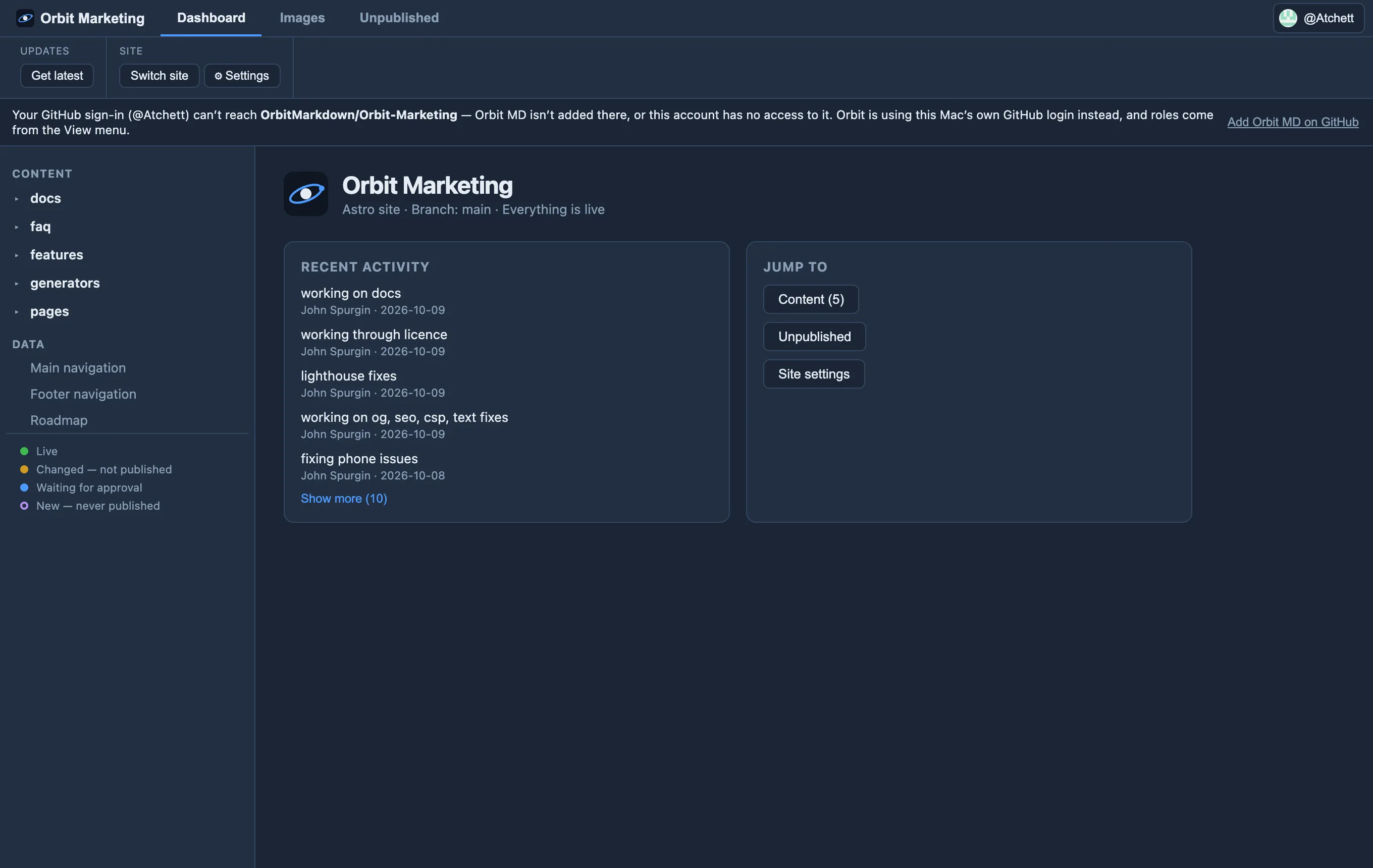
- “Your GitHub sign-in can’t reach this site” — Orbit MD isn’t added to that repository, or the account you signed in with has no access. Add it on GitHub (or ask the owner to), or check you signed in as the right account. Until then Orbit uses the computer’s own GitHub login for that site, and the View menu’s role.
- The wrong account signed in — sign out, and enter the next code in the browser signed in to the account you want.
- Your organisation uses single sign-on (SAML) — GitHub may ask you to authorise Orbit MD for the organisation once: GitHub ▸ Settings ▸ Applications ▸ Authorized GitHub Apps ▸ Orbit MD.